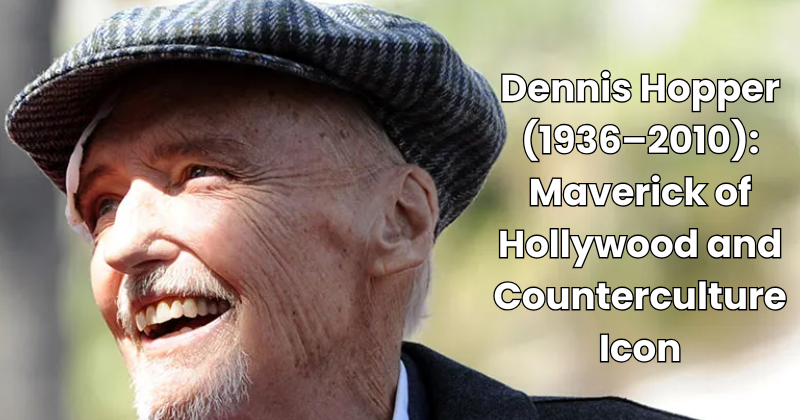
Dennis Hopper was an American actor, filmmaker, and artist whose career spanned over five decades, marked by daring choices, intense performances, and a rebellious spirit that mirrored the cultural upheavals of his time. Born on May 17, 1936, in Dodge City, Kansas, Hopper grew up in a middle-class family and developed an early interest in acting and visual arts. After studying acting at the University of California, Los Angeles (UCLA), he began his career in television during the late 1950s.
Hopper’s early roles often cast him as a villain or a troubled young man, showcasing the intensity and charisma that would become his trademark. He gained widespread recognition with his role in Rebel Without a Cause (1955) alongside James Dean, an actor whose influence on Hopper’s life and career was profound.
However, it was Hopper’s work behind the camera that cemented his reputation as a countercultural figure. In 1969, he co-wrote, directed, and starred in Easy Rider, a low-budget road movie that became a cultural phenomenon. The film’s portrayal of freedom, rebellion, and the American landscape resonated with the youth of the era and earned critical acclaim, including an Academy Award nomination for Best Original Screenplay. Easy Rider not only established Hopper as a visionary filmmaker but also symbolized the emergence of New Hollywood.
Throughout his career, Hopper was known for taking bold and unconventional roles, often portraying antiheroes, outsiders, or morally ambiguous characters. Notable performances include:
- Blue Velvet (1986) as the menacing Frank Booth, a role that revealed his capacity for dark, terrifying intensity.
- Hoosiers (1986) as a recovering alcoholic basketball coach, showcasing his emotional range and depth.
- Apocalypse Now (1979) as the photojournalist, delivering a brief but unforgettable performance.
Hopper’s life mirrored his on-screen persona: unpredictable, passionate, and at times self-destructive. He struggled with substance abuse and financial difficulties but remained a prolific artist, including painting and photography.
Dennis Hopper passed away on May 29, 2010, at the age of 74, following a battle with prostate cancer. His influence on cinema is enduring—he was a pioneer who challenged Hollywood norms, helped define a generation of filmmaking, and left behind a legacy of daring performances and visionary work. Hopper remains celebrated as one of the most audacious and fearless figures in American film history, a true maverick whose life and art defied convention at every turn.