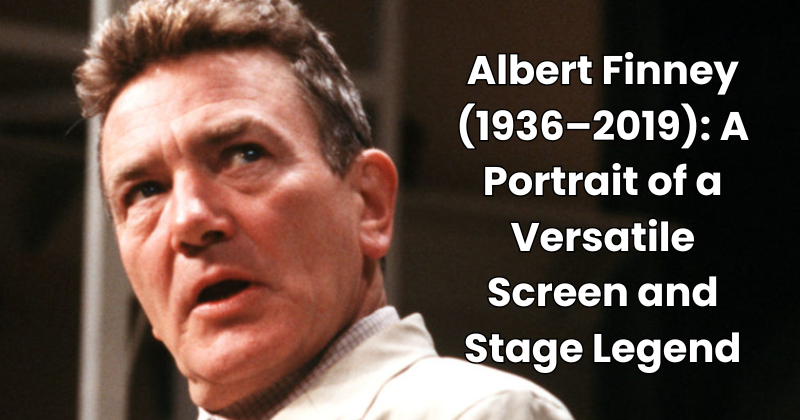
Albert Finney was one of Britain’s most distinguished and versatile actors, celebrated for a career that spanned more than five decades across film, television, and theater. Born on May 9, 1936, in Salford, England, Finney grew up in a working-class family and carried that grounded sensibility into much of his work. After training at the Royal Academy of Dramatic Art (RADA), he quickly emerged as one of the leading lights of the British acting boom of the early 1960s.
Finney’s breakthrough role came in “Saturday Night and Sunday Morning” (1960), where his raw, charismatic performance as Arthur Seaton helped define the “kitchen sink realism” movement in British cinema. His portrayal was both rebellious and compassionate, marking him as a new kind of leading man—one who looked and sounded like ordinary British life.
Throughout his career, Finney demonstrated remarkable range. He transformed himself into the exuberant title character of “Tom Jones” (1963), a performance that earned him his first Academy Award nomination and international acclaim. He later undertook an extraordinary physical and vocal transformation to play Hercule Poirot in “Murder on the Orient Express” (1974), securing another Oscar nomination.
Finney’s work extended well beyond the screen. He remained deeply committed to theater, performing with the National Theatre and other major companies, often taking on challenging roles from Shakespeare to contemporary drama. Whether in classical works or modern character pieces, he brought intensity, intelligence, and emotional depth.
In his later years, Finney continued delivering memorable performances, including roles in “Erin Brockovich” (2000), “Big Fish” (2003), and the Jason Bourne film series. He earned multiple BAFTA Awards, Golden Globes, and five Academy Award nominations over his lifetime, though he famously never attended the Oscars, preferring to keep a low profile.
Albert Finney passed away on February 7, 2019, leaving behind a legacy defined by artistic integrity, remarkable versatility, and an unwavering dedication to his craft. He remains remembered not just as an actor of exceptional talent, but as a figure who helped shape modern British cinema and theatre.