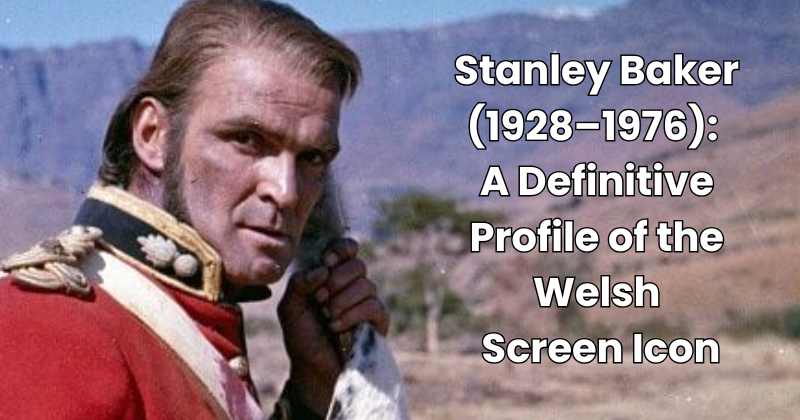
Sir Stanley Baker was a Welsh actor and film producer whose intense screen presence and commitment to gritty realism helped redefine British cinema in the mid-20th century. Known for his powerful performances in crime dramas, historical epics, and war films, Baker became one of Britain’s most distinctive leading men and later a pioneering independent producer.
Early Life and Beginnings
Born on February 28, 1928, in Ferndale in the Rhondda Valley of Wales, Stanley Baker grew up in a working-class mining community. His early exposure to local theatre sparked a passion for performance, and by his teenage years he was already recognized for his natural talent. Baker trained at the Birmingham Repertory Theatre, where he developed the disciplined, uncompromising acting style that would come to characterize his screen work.
Rise to Stardom
Baker’s early film roles in the late 1940s and 1950s portrayed him as tough, brooding, and emotionally complex—a notable departure from the more polished leading men of the era. His breakthrough came with Hell Drivers (1957), in which he played an ex-convict drawn into a dangerous trucking syndicate. The film showcased his rugged intensity and cemented his reputation as a new kind of British star.
Throughout the 1950s and 1960s, Baker built an impressive body of work, starring in films such as The Cruel Sea (1953), Violent Playground (1958), and Yesterday’s Enemy (1959). Unlike many contemporaries, he often portrayed morally ambiguous or conflicted characters, embracing realism influenced by postwar social change.
Producer and Innovator
In the early 1960s, Baker co-founded Diamond Films and later Oakhurst Productions, becoming one of Britain’s first major actor-producers. His most famous production, Zulu (1964), starred both himself and a young Michael Caine in a dramatization of the 1879 Battle of Rorke’s Drift. The film became a classic of the war genre and remains one of the most celebrated British films ever made.
Baker’s work as a producer was marked by ambition and independence. He championed stories rooted in British history and social realities and pushed for high-quality filmmaking outside the studio system.
Later Life and Legacy
By the 1970s, Baker’s health was declining due to heavy smoking, though he continued to work in both film and television. He was knighted in 1976 for his contributions to film and Welsh cultural life, becoming the first actor to receive the honor based on artistic achievement alone rather than political or public service.
Stanley Baker died later that year, on June 28, 1976, at the age of 48.
His legacy endures in his influential performances and his pioneering role in independent British film production. Today, Baker is remembered as a trailblazer: a working-class Welshman who reshaped expectations of the British leading man and expanded the creative possibilities of UK cinema.